
The Editing Mistake Almost Every Writer Makes First
Finishing a first draft is a genuine accomplishment, and the temptation to start editing immediately is completely understandable. The manuscript is fresh, the energy is still there, and the problems feel manageable. So writers open the document and start reading, and within a few paragraphs they are fixing comma placement, adjusting word choices, and smoothing out sentences that felt slightly off. It feels productive. It looks like editing. It is actually the least important work that needs to happen, and doing it first is one of the most reliable ways to miss what is actually wrong with the manuscript.
Self-editing is not about fixing small errors. It is about learning to see the structural problems that determine whether readers stay engaged from beginning to end or quietly close the book halfway through. Pacing, clarity, repetition, and structural logic are the issues that actually drive reader experience, and none of them show up when you are focused on commas. The sentence-level work matters, but it belongs at the end of the editing process, not the beginning. Starting there is the equivalent of repainting a house before checking whether the foundation is sound.
Why the Person Who Wrote the Book Is the Worst Person to Edit It
Here is the uncomfortable truth that most writing advice skips over. The writer is uniquely unqualified to spot the biggest problems in their own manuscript, at least immediately after finishing it. Your brain remembers writing every section. It remembers what a scene was supposed to feel like, how a paragraph connects to an idea three chapters later, and what you meant when a sentence came out less clearly than intended. Because of that memory, your brain fills in gaps automatically while you read, gaps that no reader will ever be able to fill because they only have access to the words on the page.
This creates a consistent and frustrating illusion. Everything feels clear to the writer because the writer is reading their memory of the book alongside the actual text. A confusing paragraph reads fine because you know what it connects to. A missing explanation goes unnoticed because you already have the answer in your head. The reader has none of that context, and the gap between what you think you wrote and what is actually there is where most manuscripts lose people. The first job of self-editing is to close that gap, and the only way to do it is to create enough distance from the manuscript that you can start reading it the way a reader would.
Distance Is the Most Underrated Editing Tool
When you finish the first draft, resist the urge to start editing right away. Put the manuscript aside for at least one week, and two weeks is significantly better. Use that time to work on something else entirely, read books in your genre, or step away from writing altogether. The goal is to return to the manuscript with a brain that is no longer filling in gaps from memory. When enough time passes, you start reading what is actually there rather than what you intended to write, and that shift makes problems visible that were completely invisible before.
A complementary technique is changing the format of the manuscript before reading it again. When you write a book, your brain becomes familiar with how the pages look on screen and begins to skim rather than read carefully. Switching the font, increasing line spacing, or exporting the manuscript as a PDF interrupts that habit and forces slower, more deliberate reading. Some writers print the manuscript and read it on paper specifically for this reason. These are small changes, but they work because they make the familiar feel unfamiliar again, and unfamiliarity is exactly the condition that allows you to see what is actually on the page.
Start With Structure Before You Touch a Single Sentence
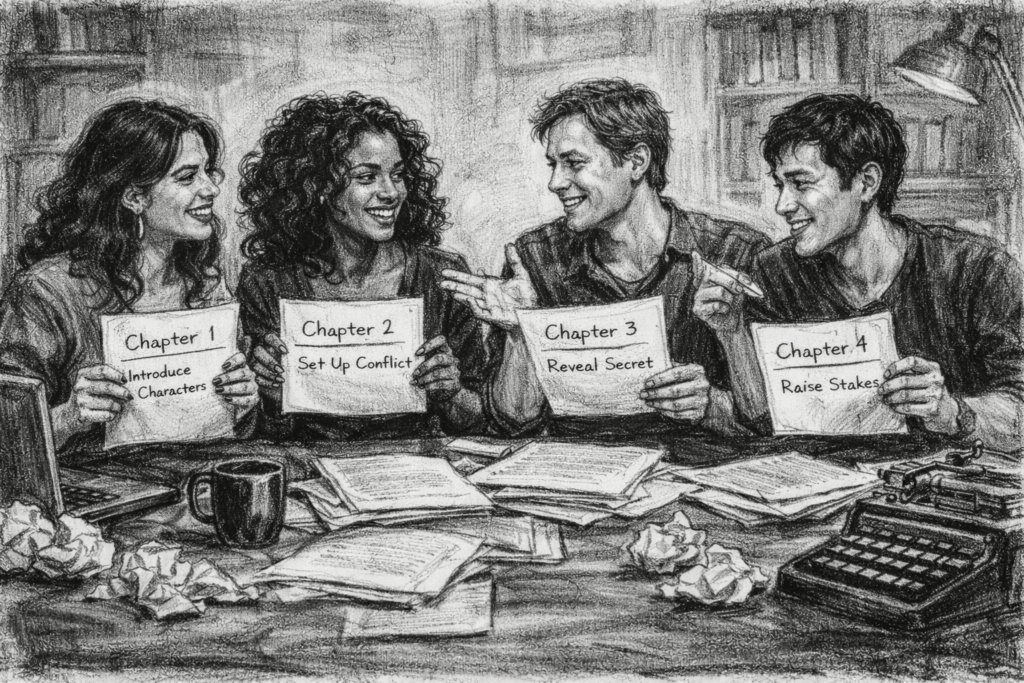
Before doing any sentence-level editing, zoom out and examine the overall shape of the manuscript. Ask whether the book moves forward in a clear and purposeful way. Identify whether any chapters are repeating ideas the reader already encountered. Evaluate whether the middle section maintains momentum or loses direction. Consider whether the ending actually resolves the central problem the book set out to address. These structural questions matter more than any grammatical issue because they determine whether the book works as a whole, and no amount of polished sentences will save a manuscript with broken structure underneath them.
Every chapter in the book should have a clear job. In nonfiction, that job might be introducing a key concept, explaining a practical framework, or guiding the reader toward a specific takeaway. If a chapter exists primarily because it was interesting to write, it may not be serving the reader. Writers often resist cutting chapters they worked hard on or feel personally connected to, but readers have no way of knowing how long something took to write. They only experience whether it helps the book move forward. Editing requires the willingness to remove material that does not serve the reader, even when that material cost real effort to produce.
The Middle Is Where Most Manuscripts Fall Apart
Many books open strongly and close well but lose momentum somewhere in the middle, and readers feel that loss immediately even when they cannot identify the source. In nonfiction, the middle often repeats ideas the reader already understands without introducing new information or raising the stakes of what is being discussed. The result is a section that feels comfortable and predictable rather than engaging and necessary. During editing, examine the middle portion of the manuscript with particular attention and ask whether each chapter introduces something genuinely new, pushes the reader’s understanding forward, or increases the urgency of what the book is building toward. A strong middle section should feel like pressure accumulating. If it feels like more of the same, readers will start skimming before they ever reach the ending.
Repetition is a related problem that runs through many first drafts without the writer noticing. An idea gets explained clearly in one section, then appears again two chapters later in slightly different language, often because the writer was concerned the reader might miss the point or simply forgot the concept had already been addressed. During editing, watch for moments where the same idea surfaces more than once. When you find them, choose the strongest version and cut the others. Readers absorb information faster than most writers expect, and trusting them to keep up produces tighter, more respectful writing.
Cut More Than Feels Comfortable
Almost every first draft is longer than it needs to be. This is not a failure of the drafting process. It is how drafting is supposed to work. The first draft is about exploration and getting ideas down. Editing is about refinement and making deliberate choices about what stays. A useful discipline is to challenge yourself to remove approximately twenty percent of the manuscript, not by deleting entire chapters arbitrarily but by trimming unnecessary words, tightening sentences that take two attempts to say one thing, and cutting repeated explanations down to their strongest version. Writers who go through this process consistently find that the manuscript becomes stronger, not thinner. Sentences move faster, paragraphs become clearer, and the overall pace improves in ways that benefit every reader who picks the book up.
Reading the manuscript out loud is one of the most effective tools for identifying where that trimming needs to happen. Silent reading allows your brain to correct awkward phrasing automatically. Reading aloud makes problems impossible to ignore. Long sentences become physically exhausting. Confusing passages create stumbles. Rhythms that felt natural on screen suddenly reveal themselves as clunky or repetitive. Any moment where you find yourself running out of breath or rereading a sentence to make sense of it is a signal that something needs work. Your voice becomes a diagnostic tool that catches what your eyes are trained to overlook.
Know What Self-Editing Cannot Do
Self-editing is powerful and necessary, but it has real limits that every writer should understand before deciding it is sufficient on its own. The same mind that created the manuscript will always carry blind spots when reviewing it. That is not a reflection of skill or diligence. It is simply the nature of working inside your own thinking. Strong self-editing brings the manuscript as far as you can take it on your own, which makes outside feedback more focused and productive when you eventually seek it. Beta readers, developmental editors, and trusted writing partners bring perspectives that no amount of self-editing can replicate. The goal of self-editing is not to eliminate the need for other eyes. It is to make the most of them when the time comes.
Take the Next Step
Self-editing is where the raw draft becomes something worth sharing. Keep building your craft with the free resources available.
R.L. Canty | Negus.Leo Publishing, LLC