
You Are Not Just Picking a Name. You Are Choosing a Legal Position.
Most creators approach naming as a creative act, and it feels that way. You sit with a notebook, test ideas, say a few out loud, and when one clicks it feels like you found something real. That feeling is legitimate, but it is also incomplete. What you are actually doing when you name a brand is not just expressing an identity. You are selecting a legal position you will have to defend in a marketplace full of other people who made the same kind of decision. If that position overlaps with someone else’s protected territory, your creativity does not matter. Their prior claim does, and that is where many creators get blindsided before they ever see it coming.
The mistake is not enthusiasm. Enthusiasm is the right starting point. The mistake is letting enthusiasm replace verification, and doing so at a moment when the emotional investment is high enough to make honest evaluation feel threatening.
Why Falling in Love With a Name Too Early Is a Business Risk
There is a pattern that shows up consistently among creators who end up in trademark trouble. A name lands and feels right, so building begins immediately. The domain gets purchased, social handles get locked in, a logo gets drafted, and sometimes a book cover gets designed. By that point the name is no longer just a name. It is part of a growing system, and walking away from it starts to feel genuinely painful. That pain is the problem, because emotional investment changes how people evaluate information. Instead of asking whether the name is safe, they start looking for reasons to justify keeping it. Near matches get ignored. Similarities get minimized. Small differences get treated as sufficient distance. This is not carelessness. It is attachment doing exactly what attachment does, and trademark law has no patience for it.
Trademark law evaluates confusion, not intention. If your name is close enough to an existing mark to cause a mix-up in the mind of a customer, the fact that it felt original to you is not relevant to the outcome. That is why so many rebrands happen after launch instead of before it. By the time the truth becomes unavoidable, the cost of change has multiplied several times over.
A Google Search Is Not Due Diligence
Typing a name into a search engine feels like responsible research, but it is closer to surface-level reassurance than actual risk assessment. Search engines are built to show what is popular, what is optimized, and what is easy to find. Trademark conflicts regularly exist outside that visibility, particularly in niche markets or under registered but less prominent brands that simply do not rank well in search results.
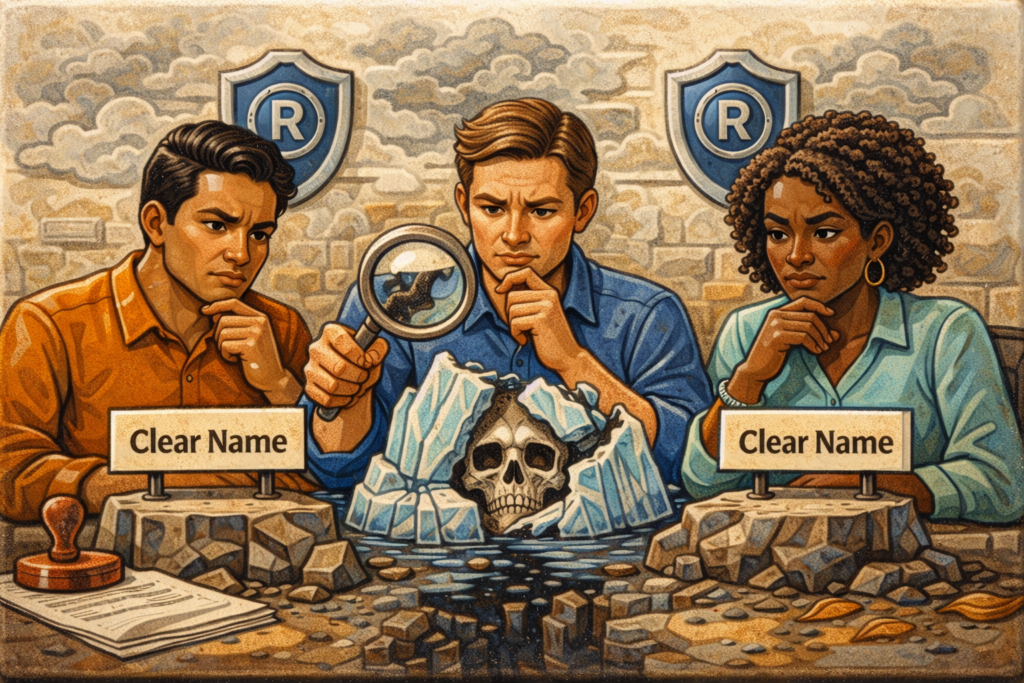
The deeper issue is that trademark law does not evaluate exact matches. It evaluates similarity, which includes sound, appearance, and the overall impression a name creates. A name can be spelled differently and still be considered too close. It can look different on paper and still sound similar enough to create confusion in practice. The feeling a name communicates can even be part of the legal analysis. A proper search starts with the United States Patent and Trademark Office database, not as a backup step but as the primary tool. State-level records matter as well. Domain availability and social media presence help fill in the picture, but they are not the deciding factors. The key question is always whether someone could reasonably assume two brands are connected. If the honest answer is even possibly, you are not in safe territory yet.
The Names That Feel Safest Are Often the Weakest
There is a persistent belief that a clear, descriptive name is a strong name. If it tells people exactly what you do, it feels logical, professional, and easy to understand. That logic breaks down directly in trademark law. The more closely your name describes your product or service, the harder it becomes to protect, because you are essentially using language that every other business in your category also needs access to. You cannot claim exclusive rights over words the entire industry depends on.
This creates an outcome that surprises most people. A name like Professional Publishing Services communicates clearly and sounds credible, but it offers almost no legal protection and does nothing to distinguish you from competitors doing the same work. It blends in rather than standing apart. Stronger names create distance from the obvious. They are distinctive enough to carry identity on their own without relying on describing the service directly. They feel less immediately clear at launch, but they become far more powerful over time precisely because they can be owned in a way descriptive names cannot.
Trademark Classes Are Strategy, Not Paperwork
When most people hear about trademark classes, they treat them like a technical formality. They are not. They are a direct reflection of how you define your business and how far your protection will actually reach. When you file a trademark, you are not claiming your name in a universal sense. You are claiming it within specific categories of goods and services, and choosing the wrong categories is one of the most common and consequential mistakes in the process.
For authors and content creators, relevant classes can include printed books, digital publications, educational services, and broader publishing activities. Each class represents a different lane of operation, and the lanes you choose now determine where your protection follows you later. If you file only under printed books but eventually expand into courses, coaching, or consulting, your trademark may not cover those new directions. Filing too broadly creates a different problem, because the law requires real commercial activity to support each class. Claiming territory you are not actively operating in can trigger rejection. Getting this right means thinking beyond your current project and aligning your legal position with your actual business trajectory. That is not a form. It is a strategic decision dressed in administrative clothing.
What DIY Filing Actually Costs You
Filing a trademark application without professional help is entirely possible, and many people do it. The issue is not access to the system. It is the interpretation required at every step along the way. The wording of your goods and services description matters significantly. Classification must align with documented commercial use. The specimen you submit must clearly show the mark functioning in commerce. Missing or misjudging any of these elements can result in delays, office actions, or outright rejection.
When an office action arrives, the process shifts from administrative to argumentative. You are no longer submitting information. You are responding to legal concerns raised by an examining attorney, and that requires a different level of engagement than filling out a form. Many of the mistakes that lead to office actions are preventable with proper preparation upfront, and the cost savings of going it alone can disappear quickly when corrections become necessary. This does not mean professional help is always required. It means the decision to go without it should be made with full awareness of what that choice actually involves.
Not Every Title Needs a Trademark
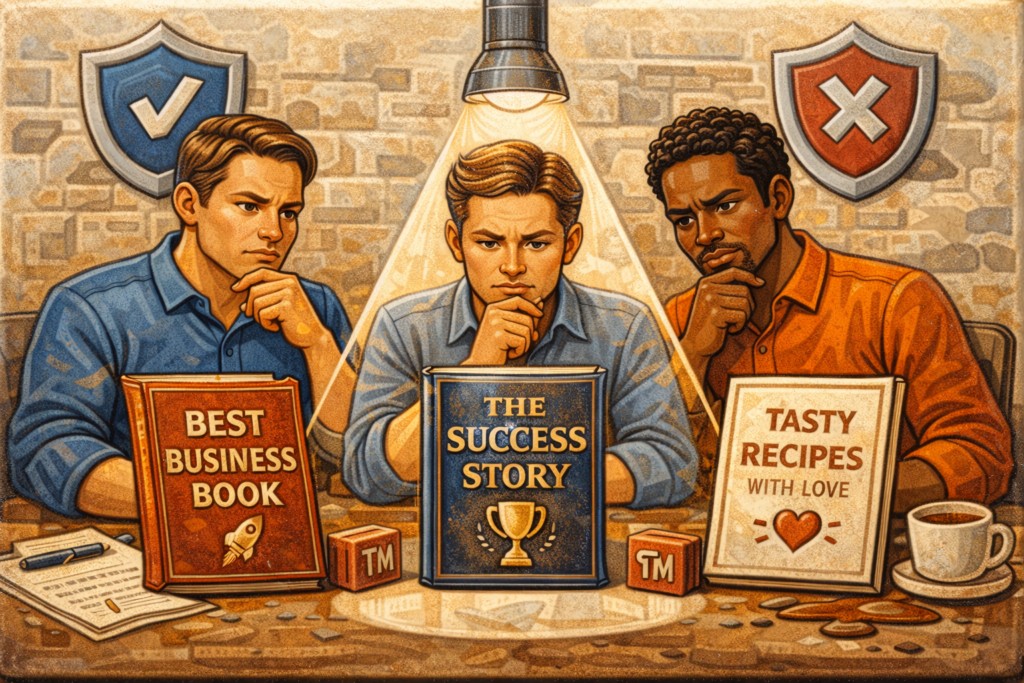
A common misconception among authors is that every book title should be trademarked. Single titles are generally not eligible for protection because they do not function as ongoing source identifiers. Trademark law is built around continuity. It protects names that signal a consistent source over time across multiple works or offerings, not individual one-time publications. This shifts the focus toward what actually deserves protection. If you are building a series, a recognizable framework, a methodology, or a publishing brand, those elements can be protected because they represent the kind of continuity trademark law is designed to cover. The book is not always the primary asset. The system around the book often is, and that system is what grows, scales, and becomes recognizable enough to be worth protecting.
A Registered Trademark Changes How Your Brand Is Perceived
Trademark protection is usually framed as a defensive move, something that prevents others from copying or interfering with what you built. That is accurate but incomplete. A registered trademark also changes how your brand is perceived by everyone who encounters it. It signals that you are operating with intention and structure, and that signal influences how partners, publishers, licensing contacts, and even competitors interact with you. Conversations about collaboration and licensing become more straightforward when the foundation is documented. The brand becomes easier to expand, easier to protect, and easier to present in new opportunities because its legal standing is already established.
The dividing line between hobby thinking and business thinking is not talent or effort. It is how decisions get made. Hobby thinking focuses on expression. Business thinking focuses on durability. When you treat your brand name as a long-term asset rather than a creative choice, your behavior changes from the start. You stop rushing toward the first idea that feels right and start testing it against the reality it will have to survive in. That shift does not slow you down. It prevents you from building something that will need to be torn down later.

Take the Next Step
A trademark is not a luxury for big companies with legal departments. It is a practical tool for anyone building something worth protecting. The earlier you move on it, the less it costs you in money, time, and stress down the road. Get started on the right foot with free publishing and author business resources.
R.L. Canty | Negus.Leo Publishing, LLC