

Most people do not avoid writing a will because they are careless. They avoid it because it feels uncomfortable. Thinking about death is awkward. It interrupts normal life. It forces questions most people would rather delay.
So they delay.
They assume they have time. They assume things will work out. They assume their family already knows what they want.
But here is the quiet truth. When someone dies without a will, the state steps in. And the state does not know your family.
A will is not about wealth. It is about control. It is about clarity. It is about making sure your wishes are not replaced by a formula written in a law book.
When you create a will, you are doing four important things. You are deciding who receives your property. You are naming someone to manage your estate. You are choosing guardians for minor children. And you are giving instructions about how personal items should be handled.
That might sound simple. It is not small.
Your estate may include your home, your car, savings accounts, retirement funds, business interests, personal belongings, and even digital assets. Some of these items carry financial value. Others carry emotional weight. Both matter.
A will appoints an executor. That person is responsible for carrying out your instructions. They gather assets, pay debts, file paperwork, and distribute property according to your wishes. Without a will, the court appoints someone to handle those responsibilities. That person may be capable. But you did not choose them.
When someone dies without a will, the legal term is intestate. It sounds technical, but the meaning is simple. The state decides.

Each state has its own rules about who inherits property. Those rules are designed to be neutral. They are not designed to reflect your personal intentions. If you are married with children, assets may be divided in ways you did not expect. If you are unmarried but have a long-term partner, that partner may receive nothing. If you have minor children, the court decides who will care for them.
The law follows a chart. It does not follow your conversations.
Families often say, “We will figure it out.” And sometimes they do. But grief changes people. Stress makes small issues feel bigger. Money and property add pressure. Even close siblings can disagree when decisions feel unclear.
Without a will, someone must go to court and ask to be appointed as administrator. Assets may be temporarily frozen. Bills still need to be paid. Mortgages still exist. Life does not pause while paperwork catches up.
Blended families face even more complexity. Children from prior marriages, stepchildren, and new spouses may all have expectations. Without written instructions, state law decides how those interests are balanced. That decision may not reflect your wishes.
There are also financial costs to inaction. Probate can take longer without clear direction. Legal fees may increase. Administrative work becomes heavier. Delays can create frustration during a time when families are already overwhelmed.
Some people believe they are too young to need a will. Age is not a shield against unpredictability. Planning is not about expecting something bad. It is about protecting others if something does happen.
Others believe their spouse automatically inherits everything. That depends on state law and family structure. In many cases, children receive a share. In other cases, parents or other relatives may have a claim. Assumptions are not the same as planning.
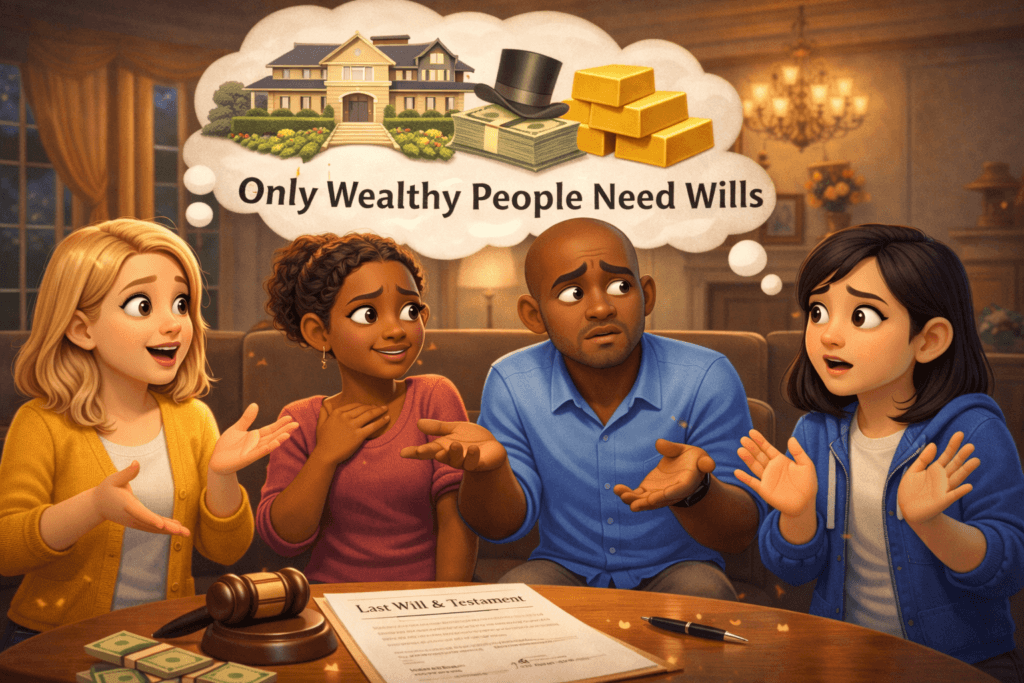
Another common belief is that only wealthy people need wills. That is simply not true. If you own a vehicle, have savings, hold retirement accounts, or possess personal property, you have an estate. The size of the estate does not determine whether clarity is valuable.
Parents of minor children carry one of the strongest reasons to have a will. Naming a guardian is not automatic. Without written direction, a judge must decide who will raise your child. That decision may align with your wishes. It may not. Leaving that choice to the court is a risk many parents do not fully consider.
Business owners also need direction. If you own part of a company, your ownership interest must transfer in a coordinated way. Without planning, that transition can disrupt operations and create tension among partners.
It is also important to understand what a will does not do. A will does not avoid probate entirely. It does not override beneficiary designations on life insurance or retirement accounts. It does not control property that is jointly owned with rights of survivorship. Estate planning is broader than one document.
Still, the will is often the foundation.
At its core, a will is a statement of responsibility. It says you took the time to think about what happens next. It says you cared enough to reduce confusion. It gives your family direction during a season when they may feel lost.
This is not about fear. It is about leadership.
When you create a will, you are not preparing for death in a dramatic way. You are preparing your family for stability. You are reducing the chance of conflict. You are limiting uncertainty. You are making decisions while you are clear-headed instead of leaving them to a court.
The question is not whether you enjoy thinking about this topic. The question is whether you want your intentions to be honored.
If you are an adult with assets, relationships, or responsibilities, a will is not extreme. It is practical. It is mature. It is protective.
It ensures that when your voice is no longer present in the room, your instructions still are.
That is not morbid.
That is responsible.
Most writers stop at “The End.”
Professionals start there.
If you’re serious about building books that sell, grow, and last, subscribe to the newsletter and step inside the Negus.Leo Publishing Online Library. You’ll get practical guidance, honest insight, and strategies people actually use.
Write boldly. Publish wisely. Build something that outlives the hype.
Canty