

Finishing a book feels amazing. You type the final sentence, lean back in your chair, and think, “Well, that wasn’t so bad.” Maybe you even reward yourself with coffee, pizza, or a long walk around the block.
Then a strange thought appears.
Now what?
This is the moment when many writers begin editing their manuscript. Unfortunately, they often start the wrong way. They focus on commas, spelling mistakes, and small sentence tweaks while the real problems sit quietly in the background.
Self-editing is not about fixing tiny errors. It is about learning to see the bigger problems hiding inside your manuscript. Structure, pacing, clarity, and repetition are the things that actually determine whether readers stay engaged or quietly close the book halfway through.
And here is the tricky part. The person who wrote the book is the worst person to spot those problems.
That person is you.
Why Writers Struggle to Edit Their Own Work
Your brain remembers writing the story. It remembers what you meant to say, what a scene was supposed to feel like, and how a paragraph connects to an idea later in the book.
Because of that memory, your brain fills in gaps that readers will never see.
You might read a confusing paragraph and think it makes perfect sense. In your mind, it connects to an earlier thought. But a reader does not have access to your memory. They only see the words on the page.
This creates a strange illusion where everything feels clear to the writer but confusing to everyone else.
The first step in good self-editing is creating distance from your manuscript. When you finish the first draft, resist the urge to start editing right away. Put the manuscript aside for at least a week, and two weeks is even better.
During that time, work on something else. Start outlining another idea, read a few books, or take a break from writing altogether.
When you return to the manuscript later, your brain will be less attached to it. That distance makes it easier to see problems that were invisible before.
Start With Structure Before Sentences
One of the most common editing mistakes is focusing on sentences too early. Writers begin polishing paragraphs before they know if those paragraphs even belong in the book.
That approach is like repainting a house before checking if the foundation is cracked.
Before touching individual sentences, zoom out and examine the structure of the manuscript. Ask questions about the overall shape of the book rather than the wording of each line.
Does the story move forward in a clear way? Do the chapters feel necessary, or are some of them repeating the same ideas? Does the middle section feel slow or unfocused? Does the ending actually resolve the central problem of the book?
These are structural questions, and they matter far more than grammar during the early stages of editing.
Readers rarely stop reading because of a misplaced comma. They stop because the story drags, the ideas become repetitive, or the direction of the book becomes unclear.
If the structure works, sentence-level editing becomes much easier later.
Change the Format to Trick Your Brain
Professional editors often use a simple trick to see writing more clearly. They change the format of the manuscript before reviewing it again.
When you write a book, you become familiar with how the pages look on the screen. Your brain recognizes the layout and begins to skim instead of reading carefully.
Changing the format interrupts that habit.
Try switching the font to something different, increasing the spacing between lines, or exporting the manuscript as a PDF. Some writers even print their manuscript and read it on paper instead of a screen.
These small changes force your brain to slow down and actually read the words again. Suddenly sentences that once looked fine may feel awkward. Paragraphs that seemed clear might reveal hidden confusion.
It is a simple trick, but it works surprisingly well.
Your brain reads differently when the page looks unfamiliar.
Give Every Chapter a Job
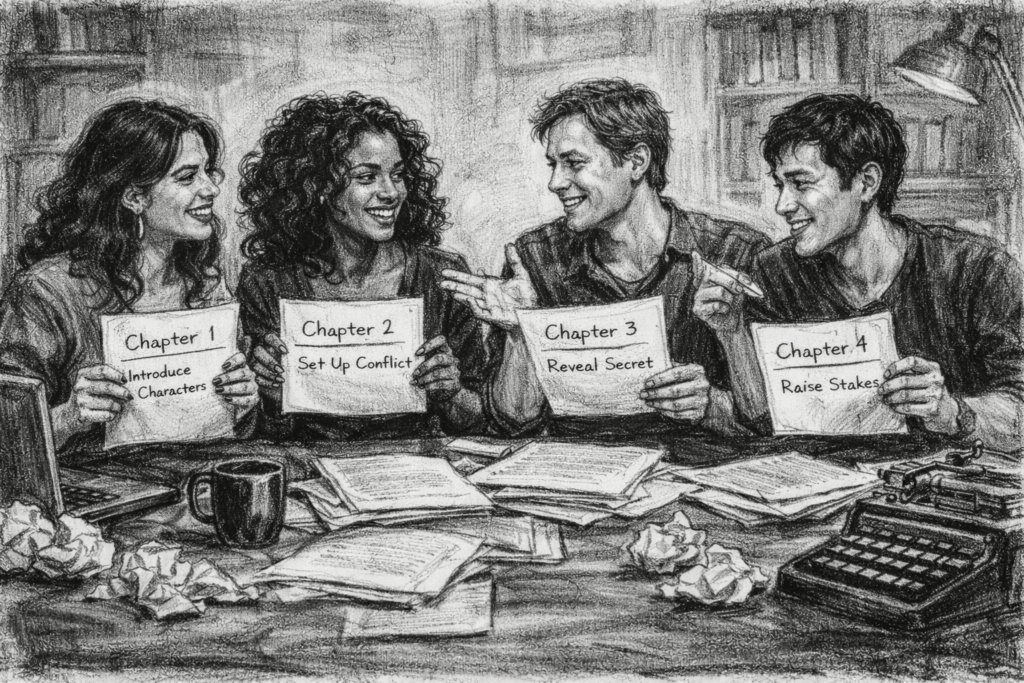
Every chapter in a book should have a clear purpose. If a chapter exists simply because it feels interesting, it may not belong in the manuscript.
During self-editing, go through your chapters one at a time and ask a simple question. What job is this chapter doing?
In fiction, a chapter might move the plot forward, reveal something important about a character, or increase tension in the story. In nonfiction, a chapter might introduce a key concept, explain an important idea, or guide the reader toward a practical takeaway.
If a chapter does not clearly serve the book’s purpose, it may be slowing the entire manuscript down.
Writers often keep weak chapters because they enjoyed writing them. Maybe the dialogue is funny. Maybe the story behind it feels personal. Maybe it took several hours to craft.
Readers do not know how long a chapter took to write. They only know whether it helps the book move forward.
Editing requires the courage to remove material that does not serve the reader.
Watch for the Slow Middle
Many books start strong and end well but struggle in the middle. This section of the manuscript sometimes becomes a place where the story wanders without clear direction.
Readers feel this immediately.
In fiction, the middle may lose tension because nothing new is happening. Characters move through scenes, but the conflict does not grow stronger. In nonfiction, the middle sometimes repeats ideas the reader already understands.
During editing, examine the middle portion of your book carefully. Ask whether each chapter introduces new information, raises the stakes, or pushes the story forward.
A strong middle section should feel like pressure building inside the story. Each chapter should increase the urgency of what is happening.
If the middle of the book feels comfortable and predictable, readers may lose interest before they ever reach the ending.
Cut More Words Than You Expect
Almost every first draft is longer than it needs to be. Writers often explain ideas twice, add extra descriptions, or include scenes that felt exciting to write but do not strengthen the story.
This is normal. The first draft is about exploration. Editing is about refinement.
A useful exercise is to challenge yourself to remove about twenty percent of the manuscript. This does not mean deleting entire chapters at random. Instead, it means trimming unnecessary words, tightening sentences, and removing repeated ideas.
When writers begin cutting, they often discover that the manuscript becomes stronger. Sentences move faster, paragraphs become clearer, and the overall pace improves.
Think of editing like pruning a tree. Removing extra branches allows the strongest ones to grow more clearly.
Readers appreciate writing that respects their time.
Look for Hidden Repetition
Repetition is one of the most common problems in early drafts. Writers often explain an idea clearly once, then repeat it later using slightly different wording.
Sometimes this happens because the author worries the reader might miss the point. Other times it happens because the writer forgot the idea already appeared earlier in the manuscript.
During editing, watch for moments where the same concept appears more than once. If you see repeated explanations, choose the strongest version and remove the others.
This simple step can tighten a manuscript dramatically.
Readers usually understand ideas faster than writers expect. Trust them to keep up.
Read the Manuscript Out Loud
Reading your work out loud may feel a little strange at first. Many writers avoid it because sitting alone and narrating their own book feels awkward.
However, this technique reveals problems that silent reading often misses.
When you read silently, your brain corrects mistakes automatically. When you read aloud, awkward phrasing becomes obvious. Long sentences suddenly feel exhausting, and confusing passages stand out immediately.
You may notice yourself stumbling over certain sentences or running out of breath halfway through a paragraph.
Those moments are signals that something needs improvement.
Your voice becomes an editing tool that helps you hear the rhythm of the writing.
Understand the Limits of Self-Editing
Self-editing is powerful, but it has limits. No writer can see every problem in their own manuscript.
The same mind that created the story will always have blind spots when reviewing it. That is simply part of human nature.
This is why many authors eventually work with beta readers, editors, or trusted writing partners. Fresh eyes bring perspectives that the author cannot easily see.
However, strong self-editing still matters. When writers improve their manuscripts before sharing them with others, the feedback they receive becomes more focused and useful.
Think of self-editing as the stage where you bring the manuscript as far as you can on your own.
Outside feedback can then help refine what remains.
The Real Purpose of Self-Editing
Many writers believe editing is about making writing perfect. That belief often leads to endless tweaking and frustration.
The real goal is not perfection.
The goal is clarity.
Readers want writing that moves smoothly, communicates ideas clearly, and keeps their attention from beginning to end. When self-editing removes unnecessary confusion, the manuscript becomes easier and more enjoyable to read.
That is what matters most.
Self-editing is the quiet stage of writing where the raw draft becomes something stronger. It is where structure improves, ideas sharpen, and the book begins to feel like a finished work instead of an early experiment.
It may not feel as exciting as writing the first draft.
But it is where good books are actually made.
Most writers stop at “The End.”
Professionals start there.
If you’re serious about building books that sell, grow, and last, subscribe to the newsletter and step inside the Negus.Leo Publishing Online Library. You’ll get practical guidance, honest insight, and strategies people actually use.
Write boldly. Publish wisely. Build something that outlives the hype.
Canty